
Single Pass, Cylinder, or Roll-to-Roll? A Comparison Guide for Packaging and Label Buyers
The platform decides the job, not the other way round. In the FOCUS Inc. range, a flat-belt single pass packaging printer such as the Cobra-1815S accepts rigid corrugated board up to 1800 mm wide and 60 mm thick; a roll-to-roll UV label printer such as the Viper-391S runs coated paper and film webs up to 320 mm wide; and a side printer such as the Acaleph-891S prints on the curved walls of cups and containers up to 300 mm high. No machine in the range covers all three formats, so the first question is not 'which model' but 'which transport system'.
FOCUS Inc. (Shanghai Focus Industrial Co., Ltd.) is a Shanghai-based industrial digital inkjet printer manufacturer founded in 2008, with a factory established in 2018 and recognised as a national high-tech enterprise from 2022. Its product matrix spans multi-pass scanning printers and high-speed single pass platforms, with 95% of output exported to the EU, USA, Mexico, Brazil, Chile, Australia, Canada and the UK.

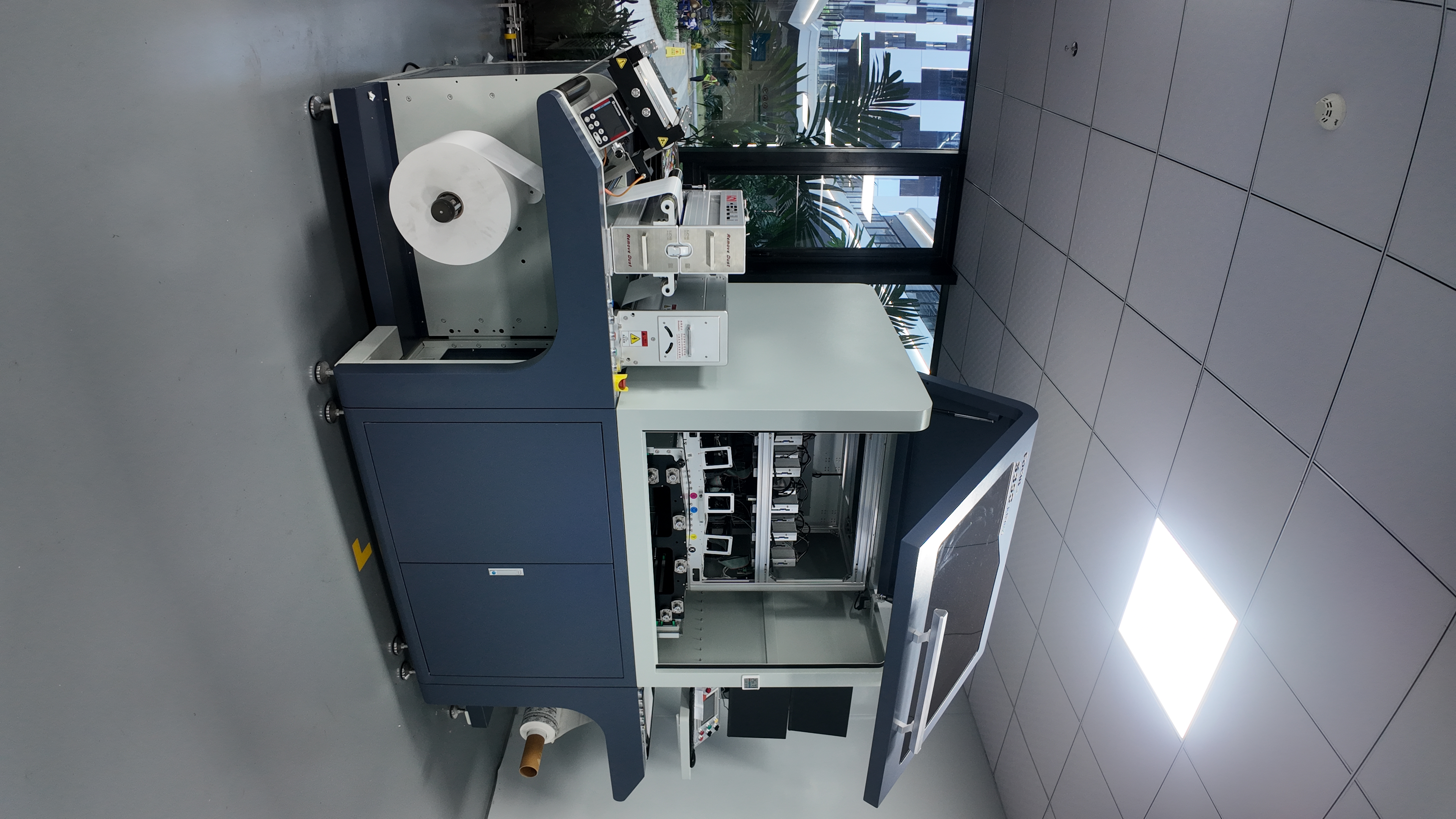
FOCUS Inc. NEXUS-350J — an all-in-one label printing, laminating, die-cutting and slitting system, one of the four platform families compared in this guide.
Why 'single pass' is a print architecture, not a machine category
Single pass means the print heads span the full print width and the substrate moves through the station once; the image is formed in a single pass rather than by repeated scanning. That definition leaves the transport system completely open — and the transport system is what actually decides which jobs a machine can take.
Across the FOCUS Inc. range, four transport systems are in use:
- Flat belt with vacuum adsorption — rigid sheets and pre-formed pieces are held flat while a servo-driven conveyor passes them under the head array. Used on the Cobra series and the Falcon-491S Pro.
- Roll-to-roll web with tension control — an unwinder feeds coated label stock or film through the print station to a rewinder. Used on the Viper-391S and the S350 Jetpress.
- Inline print plus finishing — printing, lamination, digital die-cutting and slitting are carried out in a single sequence. Used on the NEXUS-350J.
- Rotary and side-print fixtures — the head is oriented vertically, or the workpiece is rotated, so a curved or side surface is presented to the head. Used on the Acaleph-891S Side Printer and the Hydra-360S cylinder printer.
Three failure modes appear repeatedly when buyers compare on price or headline resolution alone.
Format mismatch. A 1.5 m corrugated sheet cannot be fed into a web machine, and a 0.02 mm BOPP film cannot be held flat on a belt without stretching. Load size and thickness figures on the datasheet are the fastest filter.
Ink chemistry mismatch. In this range, HP PageWide thermal bubble-jet heads are paired with aqueous, dye, pigment or edible inks, while UV-curing ink appears on the piezo-head machines — the EPSON i3200-U1 and S3200U1/U3, and the SEIKO, RICOH, XAAR, TOSHIBA and KONICA options on the Acaleph-891S. Specifying a UV ink on a thermal bubble-jet platform is not a configuration question; it is the wrong platform.
Site mismatch. Power requirements in the range run from 9A single-phase 220V on the Viper-391S to AC380V/50Hz/50A on the S350 Jetpress, and machine weights from 140 kg to 2300 kg. These are floor and electrical constraints that need checking before a purchase order, not after delivery.
Where the demand is coming from
Digital inkjet entered packaging and label production to solve a specific problem: plate-based processes carry a fixed setup cost per job and per design change. Short runs, versioned artwork, regional variants and variable data such as serial numbers and QR codes all push that fixed cost onto the buyer. Single pass printing removes the plate, which changes the economics of short and mixed batches — but it does not remove the need for a substrate-specific press.
In practice this shows up as four different buying patterns, each landing on a different platform: corrugated and honeycomb board producers adding branded outer packaging; paper bag, cup and napkin converters adding customised print to pre-formed items; label converters adding short-run and variable-data capacity; and container manufacturers printing logos directly onto finished cups, caps and bottles. Because these patterns use different substrates and different workpiece shapes, they converge on different transport systems — which is why a single 'best single pass printer' recommendation does not exist.
The four platform families in detail
1. Flat-belt single pass for rigid sheets and pre-formed pieces
This is the widest family in the range, and the one most buyers mean when they search for a single pass carton printer or a single pass box printer. Sheets are stacked on a feeder, separated one at a time — friction feeding on the Cobra-691S Max and Falcon-491S Pro, electronic automatic feeding on the Cobra-1209S and Cobra-1815S — and carried across a vacuum adsorption platform under HP PageWide heads.
The Cobra-691S Max is the compact production option for pre-formed packaging: 1–3 HP A3/A4 PageWide heads, a maximum feed width of 900 mm, a printing width of 215–645 mm depending on head count, a printing height of 0–55 mm (customisable), water-based ink at 2.5 L per colour across four colours, and 20–40 m/min. Its stated consumable cost is 0.1–0.2 RMB per square metre, and the whole machine weighs 220 kg in a 280 × 140 × 136 cm frame. That combination — paper bags, cup fans and bag boards at 900 mm feed — is why it is often the first machine bought by a converter moving from outsourced to in-house print.
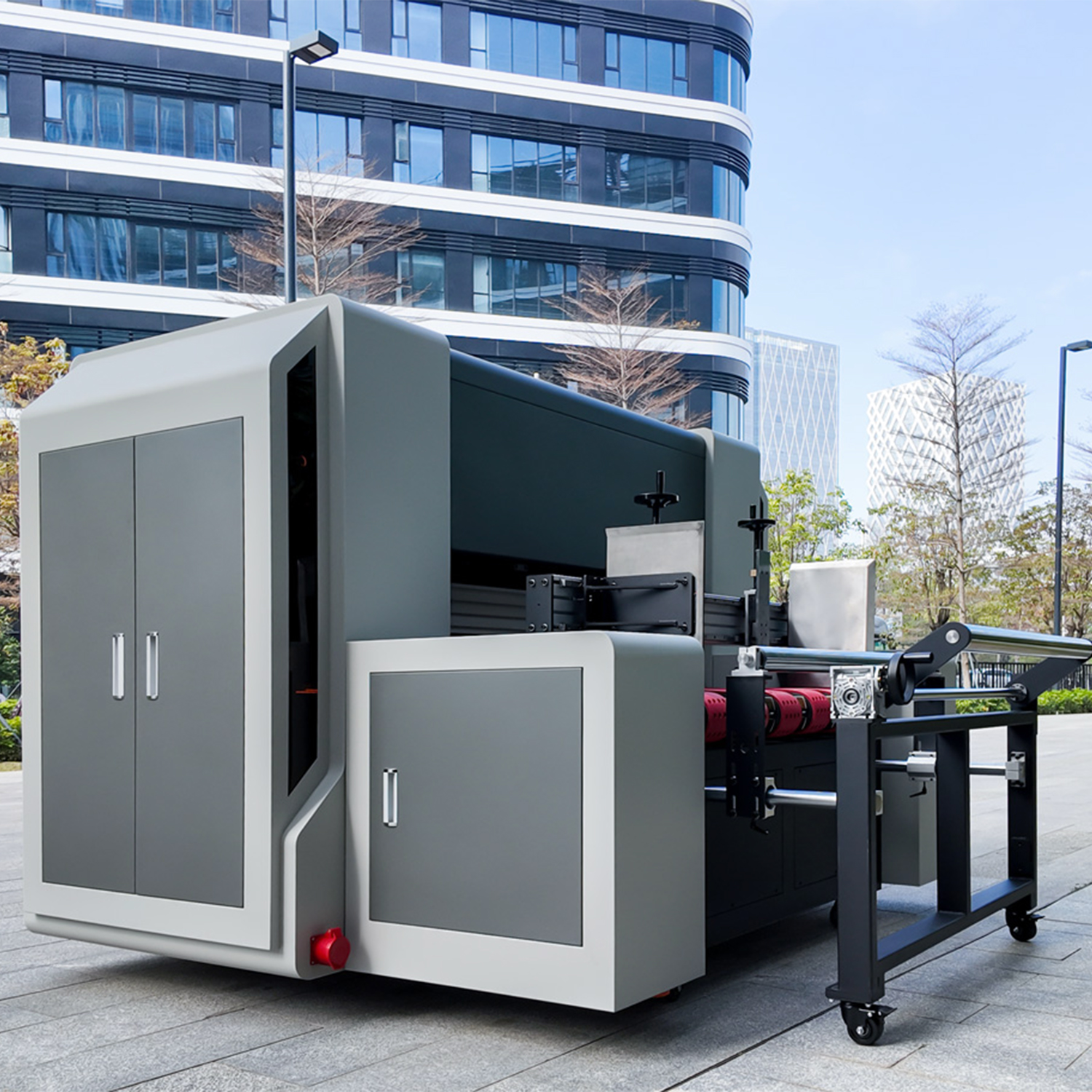
Cobra-1815S: 1800 mm load width, 900 mm maximum printing area, material thickness up to 60 mm.
The Cobra-1209S and Cobra-1815S scale the same architecture to board. The Cobra-1209S takes a 1230 mm load width and prints up to 900 mm with board thickness up to 60 mm at 10–35 m/min. The Cobra-1815S takes an 1800 mm load width, prints up to 900 mm across an unlimited length, accepts material up to 60 mm thick, and can carry 1–5 A3 heads with 59,136 nozzles per A3 head at 10–35 m/min. Both list aqueous, dye, pigment and edible ink, 1200 × 300 to 1200 × 1200 dpi, a PLC touch-screen interface and 1500 ml refillable ink tanks.
At the entry end, the Falcon-491S Pro is a desktop unit: HP A4/A3/841 PageWide heads, 210 mm (A4) or 300 mm (A3) maximum printing area with unlimited length, a 430 mm maximum load width, material thickness up to 180 mm, and 10–17 m/min. At 1375 × 744 × 872 mm and 140 kg net, it is the most compact sheet-fed unit in this comparison.

Falcon-491S Pro desktop single pass printer — 430 mm load width, 180 mm material thickness, 10–17 m/min.
2. Roll-to-roll web for labels and film
Where the workpiece is a web rather than a sheet, the constraint changes from flatness to tension. The Viper-391S is the entry roll-to-roll label platform: one HP A4 or A3 PageWide head (42,240 or 59,136 nozzles), a maximum load width of 320 mm, roll diameter up to φ350 mm, resolution to 1200 × 2200 dpi at 10–40 m/min, aqueous, dye, pigment or edible ink at 500 ml per colour, and a printer body of 629 × 598 × 600 mm weighing 65 kg, with a 51 kg unwinder and rewinder.
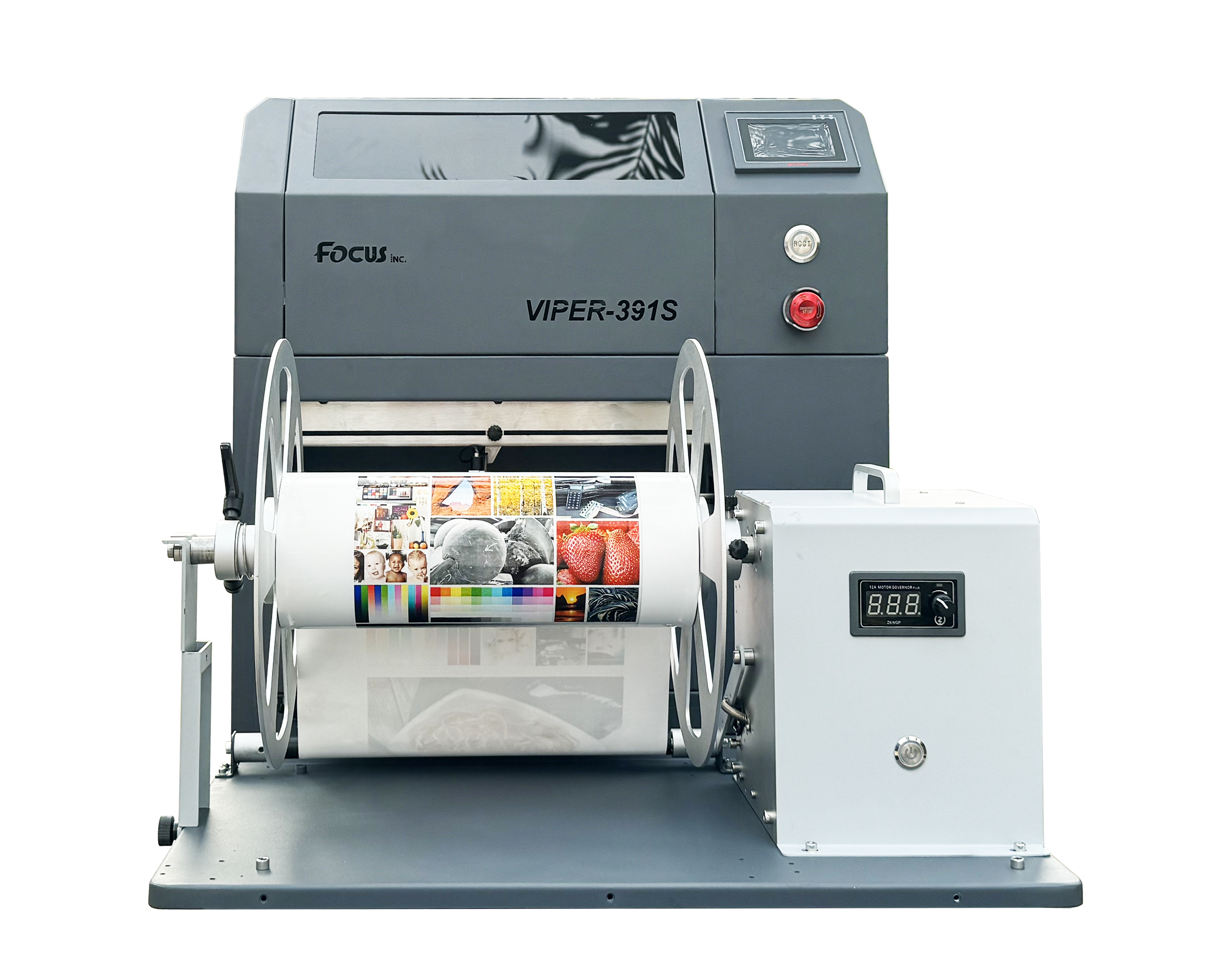
Viper-391S roll-to-roll label printer: HP PageWide head, 320 mm maximum load width, 10–40 m/min.
The S350 Jetpress is the UV production web press: EPSON S3200U1 or S3200U3 heads in 10- or 15-head arrays, 235 mm print width (120 mm per row), 1200 × 600, 900 × 600 or 600 × 600 dpi, 20–80 m/min, media thickness 0.02–0.8 mm with a maximum of 3 mm, roll diameter up to φ650 mm, LED UV curing with water cooling, 5 L ink tanks with level sensing and filtration, and a 2300 kg frame at 2800 × 1200 × 2200 mm. The 20–80 m/min band is the highest in this comparison and reflects its role: continuous film and IML work rather than mixed sheet jobs.
S350 Jetpress UV roll-to-roll press for film and IML label work: 20–80 m/min, media from 0.02 mm to a maximum of 3 mm.
The Viper-391S Pro and the Vesa-830A sit in the same family and are quoted against different width and configuration requirements; their current parameter sheets should be requested rather than inferred from the models tabulated here.
3. Integrated print and die-cutting
The NEXUS-350J answers a different question: not 'how fast can you print' but 'how many machines do I need'. It combines UV or water-based inkjet printing with automatic lamination, digital die-cutting, foil transfer, waste removal and slitting on one frame: up to four EPSON i3200-U1 heads, 720 × 720 to 720 × 1440 dpi, roll width up to 350 mm, maximum label size 330 × 300 mm, four digital die-cutting knives at 0.05 mm precision, laminating adjustable from 0 to 100 °C, and five slitting knives.
Its print speed of 1–2 m/min should be read in that context. The machine is not competing with the S350 Jetpress on linear speed; it is removing the die-cutting, waste-removal and slitting steps that would otherwise be separate equipment, separate floor space and separate labour. For a converter whose bottleneck is finishing rather than imaging, that trade is the whole point.
4. Cylinder and side printing
Curved surfaces break the flat-belt assumption entirely. The Acaleph-891S Side Printer mounts the head array vertically so that cup, bottle and container walls pass beneath it: effective printing area of 33.8–108 mm depending on head count, customisable to 350 mm; a maximum load of 600 mm × unlimited length; material thickness up to 300 mm; 600 × 300, 600 × 600 or 600 × 1200 dpi at 10–40 m/min; and a choice of SEIKO RC1536/2560, RICOH G5/G6, XAAR2002, TOSHIBA CF3/CF6, EPSON i3200-U1 or KONICA heads with UV, aqueous, pigment, dye or DTF ink at 1500 ml per colour.

Acaleph-891S Side Printer: vertical head array for cup, bottle and container walls up to 300 mm material thickness.
The Hydra-360S cylinder printer addresses 360° rotary work. In FOCUS Inc.'s certification records it is listed against the 360° rotary curved-surface utility model (Patent No. ZL 202222592510.5, Certificate No. 18207381, issued 6 January 2023 by the China National Intellectual Property Administration). Published parameter detail for this model is limited; buyers should request the current specification sheet and confirm the diameter and height range against the actual container before evaluating it alongside the side printer.
Four-step selection sequence
Step 1 — Fix the substrate and the format
Write down the material, the thickness and the delivered shape. Corrugated board at 60 mm thickness with an 1800 mm width points to the Cobra-1815S. Pre-made kraft bags, cup fans and napkins point to the Cobra-691S Max or the Falcon-491S Pro. A 0.02–0.8 mm BOPP or PET web points to the S350 Jetpress or the Viper-391S. A finished paper cup points to the Acaleph-891S Side Printer. Everything after this step is refinement; a mistake here cannot be corrected by configuration.
Step 2 — Fix the ink chemistry
Aqueous, dye, pigment and edible inks dominate the HP PageWide platforms; UV-curing inks dominate the EPSON and industrial piezo platforms. The distinction matters commercially as well as technically: water-based inks on absorbent kraft and corrugated are the lower-cost route (the Cobra-691S Max quotes 0.1–0.2 RMB per square metre), while UV inks are what make non-absorbent BOPP, PET, PVC and IML film viable — with LED UV curing at 405 nm on the Acaleph-891S and segmented water-cooled LED UV curing on the S350 Jetpress.
Step 3 — Read the speed figures correctly
Most speed figures in this range are qualified. The Cobra-1209S and Cobra-1815S quote 10–35 m/min 'according to different resolution and configuration'; the S350 Jetpress quotes 20–80 m/min 'according to print model and image quality'. The comparison that matters is not the top number but the speed at the resolution you will actually run. Test with your own artwork, not with the demo file.
Step 4 — Check floor, power and environment
Machine weights span 140 kg (Falcon-491S Pro) to 2300 kg (S350 Jetpress), and power spans 9A single-phase 220V (Viper-391S) to AC380V/50Hz/50A (S350 Jetpress). The Acaleph-891S-i and -e additionally require compressed air at a minimum of 80 psi / 6 bar and 60 L volume per plasma unit. Acoustic noise is specified at 75 dB(A) or less across most of the range. None of these are negotiable after installation.
Verified specification comparison
The table below is organised by platform rather than by model number, because the platform is what determines substrate fit.
| Print format | Substrates named in the FOCUS Inc. data | Platform | Models |
|---|---|---|---|
| Rigid board and sheet | Corrugated paper, cardboard, cellulose paper, kraft paper, pizza boxes, carton board | Flat belt with vacuum adsorption, friction or electronic feeder | Cobra-1815S, Cobra-1209S, Cobra-691S series |
| Pre-formed bags, cups, napkins, book edges | Paper bags, kraft bags, paper cups, cup fans, envelopes, cards, napkins, tissue, book edges | Flat belt / desktop single pass | Cobra-691S Max, Falcon-491S Pro, Falcon-491S |
| Label and film web | Inkjet-coated paper, BOPP, vinyl, PET, PE, PP, PVC film | Roll-to-roll with tension control | Viper-391S, Viper-391S Pro, S350 Jetpress, Vesa-830A |
| Finished label roll | Same web materials, plus foil paper and synthetic label stock | Integrated print, laminate, die-cut, slit | NEXUS-350J |
| Curved container surfaces | Paper cups, plastic cups, bottles, food containers | Vertical side-print single pass | Acaleph-891S Side Printer |
| 360° rotary surfaces | Cylindrical bodies | Cylinder platform | Hydra-360S |
Heads, ink and achievable output differ more than the platform names suggest:
| Model | Print head | Ink type | Resolution | Print speed |
|---|---|---|---|---|
| Cobra-691S Max | HP A3/A4 PageWide, 1–3 heads | Water-based | 1200×300 / 1200×600 / 1200×1200 dpi | 20–40 m/min |
| Cobra-1209S | HP A3/A4 PageWide, 1–3 A3 heads, 59,136 nozzles per A3 head | Aqueous, dye, pigment, edible | 1200×300 / 400 / 600 / 1200 dpi | 10–35 m/min |
| Cobra-1815S | HP A3/A4 PageWide, 1–5 A3 heads, 59,136 nozzles per A3 head | Aqueous, dye, pigment, edible | 1200×300 / 400 / 600 / 1200 dpi | 10–35 m/min |
| Falcon-491S Pro | HP A4/A3/841 PageWide; 42,240 nozzles on A4 head | Aqueous, dye, pigment, edible | 1200×300 / 400 / 600 / 1200 dpi | 10–17 m/min |
| Viper-391S | HP A4 or A3 PageWide (42,240 / 59,136 nozzles) | Aqueous, dye, pigment, edible | 1200×300 up to 1200×2200 dpi | 10–40 m/min |
| S350 Jetpress | EPSON S3200U1 / S3200U3, 10 or 15 heads | UV-curing | 1200×600 / 900×600 / 600×600 dpi | 20–80 m/min |
| NEXUS-350J | EPSON i3200-U1, 1–4 heads | UV or water-based | 720×720 / 720×1080 / 720×1440 dpi | 1–2 m/min |
| Acaleph-891S Side Printer | SEIKO RC1536/2560, RICOH G5/G6, XAAR2002, TOSHIBA CF3/CF6, EPSON i3200-U1, KONICA | UV-curing, aqueous, pigment, dye, DTF | 600×300 / 600×600 / 600×1200 dpi | 10–40 m/min |
Format limits, footprint and power determine whether the machine can physically be installed:
| Model | Media / format limit | Machine size | Net weight | Power requirement |
|---|---|---|---|---|
| Cobra-691S Max | Feed 900 mm; print 215–645 mm; height 0–55 mm | 280 × 140 × 136 cm | 220 kg | 220VAC 50Hz, 3 kW |
| Cobra-1209S | Load 1230 mm; print 900 mm; thickness 60 mm | 2600 × 2200 × 1820 mm | 1450 kg | 20A single-phase 220V, 50Hz |
| Cobra-1815S | Load 1800 mm; print 900 mm; thickness 60 mm | 3180 × 2200 × 1820 mm | 1650 kg | 20A single-phase 220V, 50Hz |
| Falcon-491S Pro | Load 430 mm; print 210 / 300 mm; thickness 180 mm | 1375 × 744 × 872 mm | 140 kg | 20A single-phase 220V, 50Hz |
| Viper-391S | Load 320 mm; roll diameter ≤ φ350 mm | 629 × 598 × 600 mm (printer) | 65 kg printer + 51 kg unwinder/rewinder | 9A single-phase 220V, 50–60Hz |
| S350 Jetpress | Print width 235 mm; media 0.02–0.8 mm (max 3 mm); roll ≤ φ650 mm | 2800 × 1200 × 2200 mm | 2300 kg | AC380V/50Hz/50A |
| NEXUS-350J | Roll ≤ 350 mm; label ≤ 330 × 300 mm | 2400 × 2000 × 1450 mm | 2000 kg | 25A single-phase 220V, 50Hz, 3000 W |
| Acaleph-891S Side Printer | Load 600 mm × unlimited; thickness 300 mm; print 33.8–108 mm (to 350 mm on request) | Request current sheet | Request current sheet | 42A single-phase 220–240VAC, 50/60Hz |
All figures above are FOCUS Inc. published specifications. Where a model's parameter sheet is not reproduced here — Viper-391S Pro, Vesa-830A, Cobra-691S, Falcon-491S, Hydra-360S — request the current sheet rather than transferring figures from a neighbouring model.
Purchasing terms and acceptance criteria
For a Research-to-Evaluation stage purchase, the commercial terms matter as much as print quality. The OEM and ODM capability statements give buyers a checklist to hold a supplier to.
Order terms. Minimum order quantity is 1 unit. Lead time is 15–45 days depending on the solution. Stated monthly capacity is 40 sets for ODM programmes and 120 sets for OEM programmes. Export markets covered are the EU, USA, Australia, Southeast Asia, Middle East and Latin America.
What to verify in writing before signing:
- Conformity documentation. The EC Declaration of Conformity (CE LVD & MD) is certificate SCT260301170121, issued by ANXIN PRODUCT TEST SERVICE CO., LTD. on 27 March 2026 against EN 1010-2:2006+A1:2010, EN 1010-1:2004+A1:2010, EN ISO 12100:2010 and EN 60204-1:2018+A1:2025. The matching LVD certificate carries the same number. Ask for the certificate covering the exact model and voltage configuration being purchased.
- Germany WEEE registration. Registration number WEEE-Reg.-Nr. DE 87336785, with EUREP GmbH appointed as authorised representative under the German ElektroG.
- Patent coverage where it affects your process. Relevant utility models include the UV printer nozzle protection and cleaning device (ZL 202320105006.X), the four-axis lead screw lifting ink stack (ZL 202222415831.8), the printer nozzle moisturising device (ZL 202322241497.9) and the 360° rotary curved-surface equipment (ZL 202222592510.5).
- Quality control evidence. Both capability statements specify a 100% full-machine pre-shipment running test; the ODM statement specifies a 100% continuous running aging test plus full customised function verification, with SGS/CE third-party inspection available and third-party factory audit on request. Ask for the aging-test record for your serial number.
- Warranty and spares. The ODM statement lists a 3-year machine warranty with lifelong technical consultation and spare parts supply; the OEM statement lists a 13 months free warranty with lifetime spare parts and technical upgrade guidance. Confirm in writing which applies to your contract.
- Installation and training. Both statements cover online remote technical support and overseas on-site installation and training; the ODM statement adds customised technical parameter updates.
Acceptance tests to run on your own material:
- Print your own artwork on your own substrate — not the demo file — at both the production resolution and the maximum stated resolution.
- Measure the actual linear speed at the resolution you will run, since quoted speeds are configuration-dependent.
- Run a variable-data job: serial numbers, barcodes and QR codes, checked with a scanner at production speed.
- Run an ink-adhesion cross-cut test on the finished print; UV single pass output in this range is documented as supporting cross-cut and cross-hatch adhesion testing on treated substrates.
- On the NEXUS-350J, verify die-cut precision against the stated 0.05 mm and confirm laminate temperature control across the 0–100 °C range.
- Confirm the on-site electrical supply matches the machine: 20A single-phase 220V for the Cobra-1209S, Cobra-1815S and Falcon-491S Pro; 25A single-phase 220V and 3000 W for the NEXUS-350J; 42A single-phase 220–240VAC for the Acaleph-891S; AC380V/50Hz/50A for the S350 Jetpress.
Use cases: how the choice resolves in practice
Corrugated and honeycomb board. A producer running corrugated boxes, totes and pizza boxes needs width and thickness, not web handling. The Cobra-1209S at 1230 mm load and the Cobra-1815S at 1800 mm load both print 900 mm across unlimited length at up to 60 mm thickness. FOCUS Inc. records 18 units supplied to corrugated and honeycomb board manufacturers across Colombia, Saudi Arabia, Turkey, Chile and Poland, used for appliance and electronics packaging, transit totes, shoe boxes and pizza boxes, including variable-data QR codes on turnover boxes.
Cups, containers and caps. Container side printing is a different geometry problem. Twelve units are recorded for disposable food-service container manufacturers across Turkey, Poland, Saudi Arabia, Chile and Mexico, printing logos on the outside walls of paper cups, plastic cups and paper bowls — a job the Acaleph-891S Side Printer handles with a vertical head array and a maximum material thickness of 300 mm.
Labels and IML. A label converter in Vietnam running daily-chemical, general packaging and cold-chain labels uses roll-to-roll single pass output for short runs, no minimum order quantity and variable-data QR codes without plate making. An injection moulding plant in the UAE runs IML label production on the S350 Jetpress, where the decisive specifications are the 0.02–0.8 mm media range, the φ650 mm roll capacity and UV curing that survives in-mould processing.
Non-woven and fabric bags. Soft, offset-prone material is the hardest feeding case on a belt. Three units are recorded in Brazil for non-woven, takeout and pouch bag printing, where plasma pre-treatment and a deviation-correction conveyor are used to keep ink adhesion and registration stable on soft fabric.
Frequently asked questions
Are FOCUS Inc. single pass printers CE certified?
Yes. The EC Declaration of Conformity (CE LVD & MD) is certificate SCT260301170121, issued by ANXIN PRODUCT TEST SERVICE CO., LTD. on 27 March 2026 against EN 1010-2:2006+A1:2010, EN 1010-1:2004+A1:2010, EN ISO 12100:2010 and EN 60204-1:2018+A1:2025; the corresponding LVD certificate carries the same number. For German market placement, registration WEEE-Reg.-Nr. DE 87336785 is held with EUREP GmbH as authorised representative. Buyers should confirm that the certificate on file covers the exact model, voltage and configuration being purchased, since the certificate scope is defined by model list and rated power.
Can one single pass printer handle both corrugated board and labels?
No, and the specification difference shows why. The Cobra-1815S accepts material up to 60 mm thick and 1800 mm wide on a vacuum belt; the Viper-391S accepts a web up to 320 mm wide on a φ350 mm roll with tension control and prints to 1200 × 2200 dpi. The transport systems are not interchangeable. A buyer with both product lines is comparing two machines, or selecting the platform that matches the higher-volume product and outsourcing the other.
What does running cost look like across the range?
The only published consumable figure in this range is for the Cobra-691S Max, at 0.1–0.2 RMB per square metre on water-based ink with 2.5 L per colour across four colours. Ink capacity differs by platform: 1500 ml per colour on the Cobra-1209S, Cobra-1815S and Acaleph-891S; 500 ml per colour on the Viper-391S; and 5 L tanks with level sensing and filtration on the S350 Jetpress. Because ink type, coverage and substrate absorbency differ, running cost should be calculated from a test print on your own artwork rather than extrapolated across models.
Can I get samples printed before placing an order?
Yes. Sample printing before order is part of the standard process — the Cobra-1209S documentation notes support for printing samples before an order, and customer visits for sample testing are a documented part of the factory workflow. The practical approach is to send your substrate and artwork, request printed samples at the resolution you intend to run, and evaluate colour, adhesion and registration on the finished piece. The company brochure with factory and product detail can be downloaded here: FocusInc Factory Intro (PDF).
What is the lead time and minimum order quantity?
Minimum order quantity is 1 unit and lead time is 15–45 days depending on the solution. Stated monthly capacity is 40 sets for ODM programmes and 120 sets for OEM programmes. Because lead time is quoted as a range tied to customisation — print width, feeding size, housing colour, multi-language interface and inline pre- or post-processing modules — the binding date should be fixed against a defined configuration list rather than a catalogue model number.
Conclusion
The comparison between single pass, cylinder and roll-to-roll printing resolves in a fixed order: substrate and format first, ink chemistry second, speed at your working resolution third, and floor, power and environment fourth. Applied to the FOCUS Inc. range, that sequence produces clear outcomes — the Cobra-1815S and Cobra-1209S for board up to 60 mm and 1800 mm wide, the Cobra-691S Max and Falcon-491S Pro for pre-formed bags and cups, the Viper-391S and S350 Jetpress for label and film webs, the NEXUS-350J where finishing is the bottleneck, and the Acaleph-891S Side Printer and Hydra-360S for curved and rotary work.
Price negotiation belongs after that sequence, not before it. A machine that cannot accept your substrate is not a cheaper option; it is a different product category.
Next step: put your own material through the machine
Send your substrate, artwork and target output to FOCUS Inc. for a sample print evaluated against the criteria in this guide — resolution at production speed, ink adhesion by cross-cut, variable-data readability and die-cut precision where applicable. Request a configuration-specific quotation with model, voltage, feeding size and warranty terms stated in writing.
Email: info@focusdgt.com · Tel / WhatsApp: +86 177 6513 2139 · www.focusincprinter.com

Speak to FOCUS Inc. about a sample print on your own material before committing to a platform.
Have Questions or Need More Details?
Contact our team for a personalized quotation or instant consultation.
Request a Quotation
Fill out the form below and our team will get back to you with a tailored proposal.
WhatsApp Direct Chat
Prefer to chat in real-time? Message us on WhatsApp for instant assistance & quick answers.
- Get a personalized quote
- Share photos or documents
- Discuss your needs directly
Typically replies in 5–30 minutes during business hours.