
Single Pass Printer 101: Core Concepts for Packaging & Label Digital Inkjet
Digital Inkjet Fundamentals
Single Pass Printer 101: Core Concepts for Packaging & Label Digital Inkjet

A single pass printer is a digital inkjet system whose print head array spans the full print width, so the complete image is formed while the substrate moves past the heads once. That definition is architectural, not commercial. It does not tell you the resolution, the ink chemistry, the substrate range, or the throughput. This guide separates the category into its four building blocks — print heads, ink chemistry, media handling, and curing and finishing — and explains what each one changes for a packaging or label buyer.
Most of the confusion around the term comes from treating it as a product grade. In practice, two machines that both qualify as one pass printers can differ enormously: a desktop single pass packaging printer for paper bags and pizza boxes, and a wide-format single pass printer for corrugated printing, share the same underlying architecture but almost nothing else.
What a Single Pass Printer Actually Is
A single pass printer completes the image in one relative movement between the substrate and the print head array. The array is stationary across the print width during production. Every nozzle belonging to a given pixel column fires during that single traverse, so the number of passes does not enter the throughput calculation. This is the property that separates the category from scanning inkjet.
A multi-pass scanning inkjet printer carries a narrower head assembly back and forth across the substrate. Each traverse deposits one band of the image, and the substrate advances by a fraction of the head width between passes. Image completion requires several passes, and production time scales with that count. Registration between passes has to be controlled continuously, because errors accumulate across the stroke sequence rather than appearing in a single event.
Rotary and cylinder printing takes a third route. The object rotates and the head prints around its circumference, so the image is wrapped onto a curved surface rather than being laid onto a flat sheet or web. FocusInc's Hydra-360S uses a 360-degree helix print mode with an EPSON i3200-U1HD head and handles cylinders and tapers from 42 mm to 135 mm in diameter, with a media length up to 240 mm and a taper angle up to 13 degrees.
The practical consequence of the architecture is asymmetric. Single pass gives high linear throughput because image formation is not repeated. It also concentrates risk: a single blocked nozzle leaves a visible line running the full length of every print, which is why nozzle redundancy, carriage anti-scratch protection, keep-wet capping, and head cleaning routines matter more in this category than in scanning systems. FocusInc holds a China National Intellectual Property Administration utility model patent for a UV printer nozzle protection and cleaning device (Certificate No. 19070387, Patent No. ZL 202320105006.X), which is the kind of engineering detail that belongs on an evaluation checklist rather than in a sales claim.
Why the Category Is Hard to Compare
Three problems recur when buyers put single pass systems side by side for the first time.
- One label, very different machines. The Falcon-491S is a desktop unit with an HP A4 and HP A3 Pagewide head, a 400 mm maximum media width and 180 mm maximum thickness, printing at 10–25 m/min. The Cobra-1815S holds one to five HP A3 heads, prints up to 900 mm wide across an 1,800 mm load width, and runs at 10–35 m/min on corrugated and carton board. Both are single pass printers.
- Specifications that look comparable but are not. A quoted resolution of 1200 dpi can mean different things depending on whether the perpendicular axis is 300, 600, or 1200 dpi and on which print mode was used to reach it. A quoted speed in metres per minute is meaningless without the resolution and ink load at which it was measured.
- Media handling decides the project. In label and corrugated work, the feeder, the web guide, the tension control, and the take-off unit determine whether a system fits the line. They are frequently the reason a technically suitable print engine fails a site evaluation.
A useful evaluation sequence therefore runs from substrate backwards, not from print head forwards.
Where the Category Sits in Packaging and Label Production
Digital printing for packaging was valued at USD 31.64 billion in 2023, with a forecast reaching USD 75.55 billion by 2032 according to Zion Market Research. Forecasts differ widely by scope: published 2032 figures from other research houses range from roughly USD 27.4 billion to USD 62.8 billion, so the growth direction is more reliable than any single endpoint number.
Within the broader digital printer market, the inkjet segment held a 42.5% share as of 2025, according to Straits Research. That matters for this category because single pass architecture is an inkjet architecture — it inherits the inkjet cost curve, the inkjet substrate constraints, and the inkjet maintenance profile.
On the demand side, China produced more than 88 billion square meters of corrugated board in 2024, according to the China Packaging Federation and Dataintelo. Corrugated and carton work is where the economics of a single pass carton printer or single pass box printer are easiest to justify, because the alternative is a plate-based process with setup time and plate inventory attached to every order change.
The commercial driver is not print quality alone. It is the combination of no plate-making, variable data capability, and the ability to accept short runs without amortising a setup cost across them. Those three properties are what make the category relevant to packaging buyers rather than only to commercial printers.
The Four Building Blocks of a Single Pass System
Every system in this category is a configuration of four modules. Buying decisions go wrong when one module is optimised in isolation — a high-resolution head paired with an incompatible ink, or a wide print width paired with a feeder that cannot register the sheet.
1. Print heads: the platform decision
The print head sets the feasible envelope for resolution, speed, and ink type simultaneously. FocusInc's range spans two dominant platforms, and the difference between them is not a quality ranking.
HP PageWide thermal bubble-jet heads are used across the Cobra and Viper packaging and label lines. A single HP Pagewide head carries 42,240 nozzles arranged in 10 rows of 4,224. The A3 variant carries 59,136 nozzles in 14 rows. On the Cobra-691S, one or two heads produce print widths of 210 mm or 420 mm, with resolution settings of 1200×300, 1200×400, 1200×600, and 1200×1200 dpi at 10–40 m/min. The Viper-391S adds a 1200×2200 dpi setting on the same head family. The Cobra-1209S and Cobra-1815S use one to three and one to five HP A3 heads respectively.
EPSON i3200-U1 piezo heads appear where jetting control and ink flexibility dominate. On the NEXUS-350J, one to four i3200-U1 heads each carry 3,200 nozzles in a 400 × 8 row layout, run at a jetting frequency of 21.6–43.2 kHz, deliver 3.5–12.5 pl drop volumes with 2–4 greyscale levels, and print at 720×720, 720×1080, or 720×1440 dpi. The Vesa-830A uses two i3200-U1 heads in a roll to roll UV label configuration.
EPSON S3200 with internal circulation is the platform behind the S350 Jetpress roll to roll UV label printer. It runs 10 or 15 heads in CMYKW×2 or CMYK×3 arrangements, with a 235 mm print width (120 mm per row), droplet sizes of 5–15 pl for white and 3.5–5–10 pl for colour, and production speeds of 20–80 m/min depending on print mode and image quality.
The Acaleph UV single pass series takes configurability further, listing SEIKO RC1536/2560, RICOH G5/G6, XAAR 2002, TOSHIBA CF3/CF6, EPSON i3200-U1, and KONICA heads as options. That flexibility is useful in industrial and decorative applications, but it also means the head choice must be tied to a specific substrate and ink before it means anything.
Two practical rules follow. First, adding heads generally adds print width rather than speed. Second, on a given head platform, higher resolution settings reduce achievable line speed — the two figures must always be read as a pair.
2. Ink chemistry: what the substrate will accept
Ink selection is a substrate decision before it is a colour decision. The FocusInc range covers three families.
Aqueous, dye, and pigment inks are standard on the packaging lines: Cobra-691S, Cobra-1209S, Cobra-1815S, Falcon-491S, and Viper-391S. They suit absorbent stocks such as corrugated board, kraft paper, carton board, paper bags, coffee bags, envelopes, napkins, and tissue. The Viper-391S specification is explicit about the constraint that comes with this family: approved media are inkjet-coated paper and synthetics such as BOPP, vinyl, and PET, in gloss or matt finish. Uncoated film will not hold an aqueous image without treatment.
UV curing inks are standard on the Acaleph series, S350 Jetpress, and Vesa-830A, and available on the NEXUS-350J and Hydra-360S. They extend the substrate range to non-absorbent materials: BOPP, PET, PVC, PE, PP film, foil paper, glass, ceramic, metal, and coated board. Curing happens inline, so the printed surface can be handled immediately rather than drying on a rack.
White ink and varnish are the finishing layer that makes transparent and coloured substrates usable. The NEXUS-350J is configured as White + White + KCMY + Varnish depending on head count, with automatic white ink stirring and an automatic white ink circulation system. The Vesa-830A carries a dedicated 500 ml white ink tank alongside 220 ml colour tanks, with the same stirring and circulation functions. Acaleph models list primer, white, and gloss varnish as spot options.
Several models — Falcon-491S, Viper-391S, Cobra-1209S, Cobra-1815S, Vesa-830A, and the Cobra-691S AS B configuration — also list edible ink among supported ink types, alongside coated paper, cake pads, and food-contact-adjacent substrates. Listing an edible ink option is not the same as a food-contact compliance statement. Buyers in food packaging should verify migration testing and the applicable regional framework independently rather than reading a specification sheet as a certificate.
Where adhesion is the risk, surface pre-treatment closes the gap. Acaleph models offer plasma, flame, or corona pre-treatment depending on the material. In a documented PVC decorative panel project, the solution incorporated a plasma treatment stage specifically to raise ink adhesion so the finished board could pass cross-hatch adhesion testing.
3. Media handling: the module that decides fit
Single pass systems in this category use three transport formats, and the choice usually follows the substrate rather than the print engine.
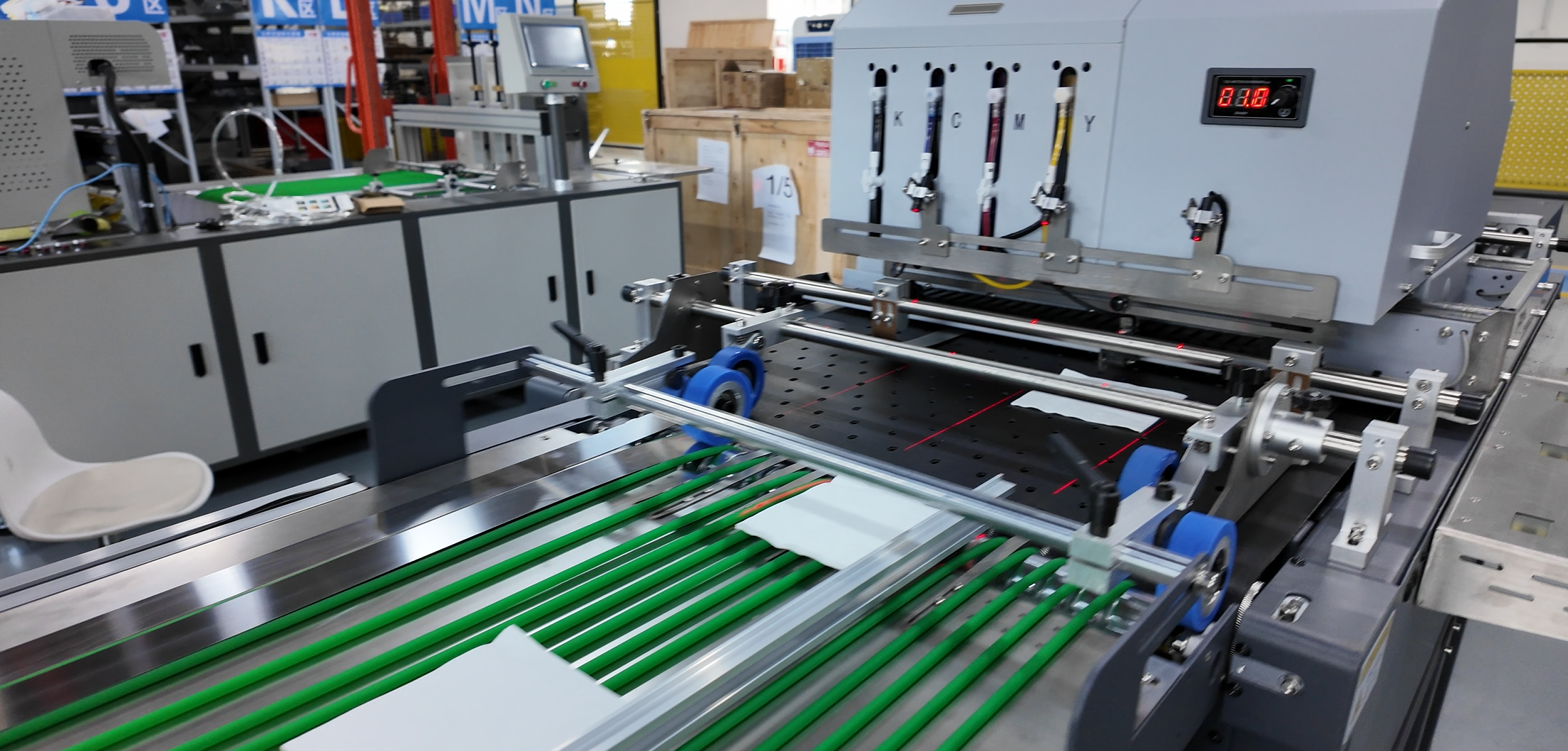
Sheet and flatbed transport covers rigid and semi-rigid work. The Cobra-691S accepts a 600 mm load width without side flanks and 1,200 mm with them, at a maximum thickness of 250 mm, aligned by four to six automatic laser guideline margins. The Cobra-1209S accepts a 1,230 mm load width at 60 mm maximum thickness, and the Cobra-1815S accepts 1,800 mm at the same thickness. The Acaleph series accepts 600 mm at up to 300 mm thickness and offers an electronic friction feeder for normal soft and rigid media or an air vacuum feeder for very soft material such as plastic film and soft bags.
Roll to roll transport covers labels, film, and web work. The Viper-391S takes a maximum web width of 320 mm with a roll outer diameter up to 350 mm and core diameters of 75, 40, or 25 mm, and supports roll-to-roll, roll-to-cut, and print-hold modes. The NEXUS-350J takes roll stock up to 350 mm wide with automatic tension unwinding and rewinding plus electronic correction and full-follow tension control. The S350 Jetpress runs media from 0.02 mm to 0.8 mm thick, up to 3 mm in some configurations, on 650 mm rollers with 3-inch gas-boosted shafts.
Cylinder transport covers containers, caps, tubes, and bottles. The Hydra-360S handles diameters from 42 mm to 135 mm and lengths up to 240 mm on glass, ceramic, metal, carton, and plastic bodies, at 40–120 pieces per hour depending on print mode and image size.
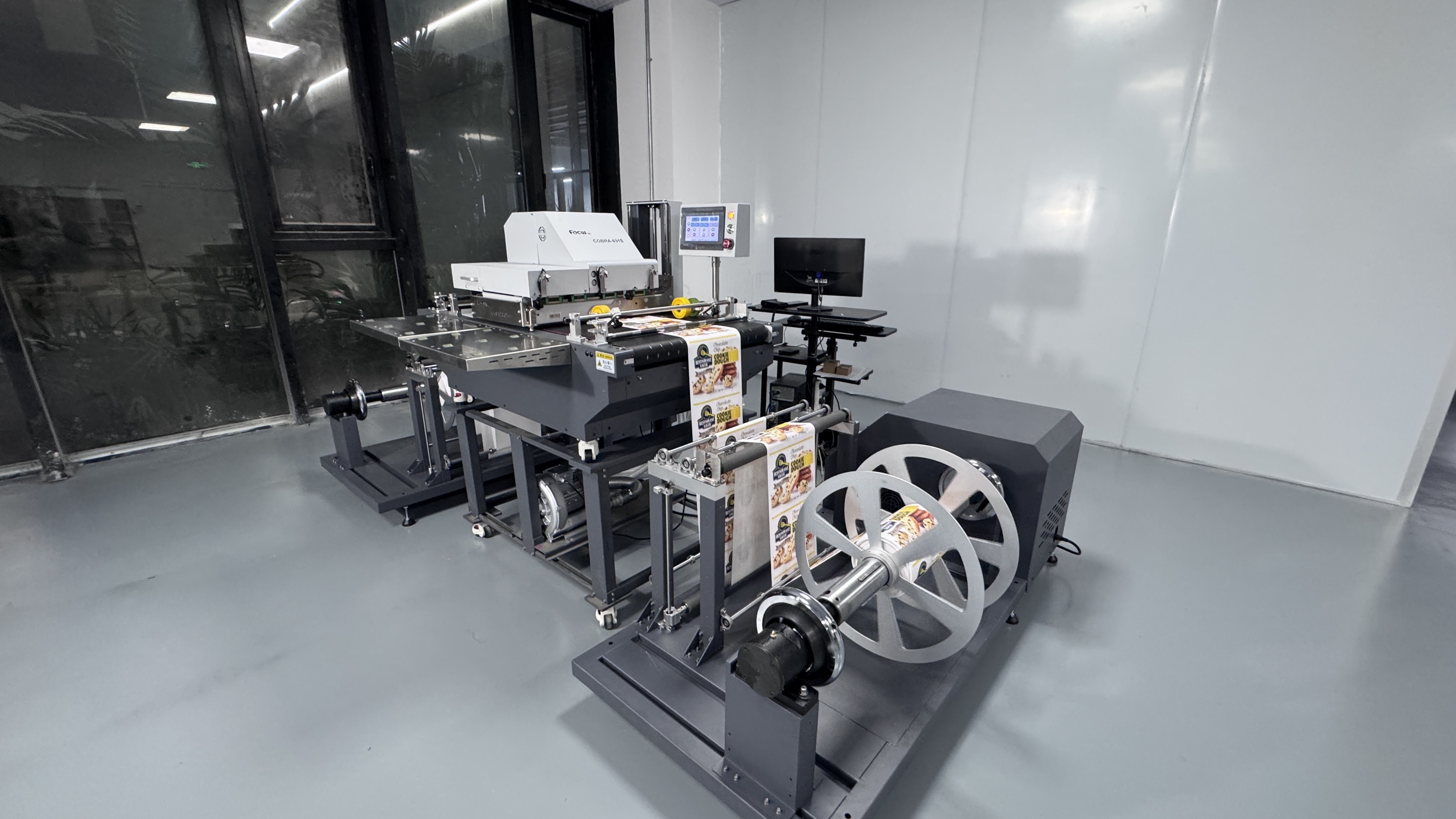
Media handling is also where customisation concentrates. A non-woven bag single pass printing machine deployment typically needs a friction feeder and a collection unit rather than a precision web guide. A single pass digital inkjet paper bag printer installation in a converting line usually needs the print station integrated with upstream bag forming and downstream stacking. Neither requirement appears in a print head datasheet, and both affect delivery time.
4. Curing and finishing: closing the loop
Curing is not a peripheral. It determines whether the printed surface can be stacked, wound, die-cut, or laminated immediately, and it constrains the ink chemistry that can be used at all.
On UV systems, FocusInc specifies 405 nm LED curing. The Vesa-830A uses two 405 nm UV-LED lamps. The Hydra-360S uses a 405 nm LED source adjustable from 0 to 480 W with water circulation cooling. The Acaleph series uses 405 nm LED curing in sectional zones, also water cooled, which lets the operator cure selectively rather than flooding the whole web. The S350 Jetpress pairs LED UV curing with a water colouring system for the roller circuit.

On aqueous systems, drying depends on absorption and forced air, which is why approved coated media and pre-treatment carry more weight on packaging models than on UV models.
Inline finishing is what turns a roll to roll single pass label printer into a label production line rather than a printing press. The NEXUS-350J integrates digital die cutting for regular and irregular shapes with four knives at 0.05 mm precision, automatic electronic lamination after printing at an adjustable 0–100 °C, gold or foil stamp transfer, and physical slitting with five knives. Without that stage, printed labels still need a separate finishing pass, and the labour saving that justified the investment evaporates.

Step-by-Step: Specifying a Single Pass System
The following sequence keeps the four modules in the right dependency order. It applies equally to a first-time one pass printer buyer and to a converter replacing an existing line.
- Fix the substrate and the format. Name the material, the caliper, the piece size, and the daily volume. Corrugated board at 60 mm thickness and BOPP label film at 0.05 mm lead to different transports, different inks, and different curing before any print head is discussed.
- Choose the transport format. Rigid sheets point to flatbed configurations such as the Cobra series; webs point to roll to roll such as the Viper-391S or S350 Jetpress; containers point to cylinder systems such as the Hydra-360S.
- Size the print width from the job, not from the machine. The Cobra-691S delivers 210 mm from one head and 420 mm from two. The Cobra-1209S reaches 900 mm with one to three A3 heads. Over-specifying width costs floor space and money without improving the job.
- Match the ink family to the surface energy of the material. Absorbent paper stocks take aqueous, dye, or pigment ink. Non-absorbent film, foil, glass, and metal need UV curing ink, often with a primer and frequently with plasma, flame, or corona pre-treatment.
- Confirm curing and finishing inline. Decide whether the output must be rewound, die-cut, laminated, slit, or stacked straight off the machine. The NEXUS-350J exists precisely because label buyers wanted all of it in one footprint.
- Check the software and data path. RIP and control are part of the specification. FocusInc models ship with control and RIP combined, accept Tiff, PNG, JPEG, and PDF input, and run on Windows 7, 10, or 11 (64-bit) with an Intel Core i5 at 2.5 GHz or higher and 8 GB RAM or more.
Use Cases: What These Concepts Look Like in Production
Field installations make the abstract modules concrete, because each project solved a specific constraint rather than a general one.
- Label and cold-chain work, Vietnam. A roll to roll label printer has run for two years on daily chemical labels, general packaging labels, and cold-chain logistics labels. The stated result was rapid order processing with no minimum order quantity and variable-data QR printing without plate-making — the classic case for a single pass sticker printer platform.
- IML film, United Arab Emirates. One S350 Jetpress has run for two years on in-mould labelling film. Synchronous white and colour printing in one pass reduced manual labelling cost by 40%, with zero ink peeling during high-temperature injection moulding — a curing and adhesion outcome, not a resolution outcome.
- Paper cups and food containers, five markets. Twelve units across multiple lines in Turkey, Poland, Saudi Arabia, Chile, and Mexico print logos on finished paper cups, plastic cups, and paper bowls, running for two years and supporting on-demand customisation with rapid delivery.
- Non-woven and takeaway bags, Brazil. Three UV single pass units have run for three years on non-woven bags, takeaway bags, and plastic bags, with no minimum order quantity, plate-free printing, and consistent quality — the pattern that defines a non-woven bag single pass printing machine deployment.
- Book edges, Spain and the Philippines. Two book edge printing lines have run for two years at over 2,500 books per hour, printing personalised designs on spines with plate-free production and instant job switching. This is a case where a jig and a fixture, not a print head, defined the solution.
- PVC panels and decorative board, four markets. Three UV single pass units in Portugal, Spain, Mexico, and Poland have run for three years on PVC sheet panels and decorative board, eliminating inventory backlog and cutting sample turnaround to roughly two seconds of printing time.
- Corrugated and carton, global. Eighteen units across multiple markets print on corrugated boxes, gift boxes, and shipping cartons with variable QR coding, enabling multi-batch personalised packaging with no plate-making — the reference pattern for a single pass printer for cardboard printing investment.
Comparison: Architectures and Configurations
The first table compares the three inkjet architectures used in packaging and label work. It intentionally contains no speed or resolution numbers for multi-pass systems, because those figures vary by machine and cannot be generalised responsibly.
| Architecture | How the image is formed | Typical production role | Main constraint to manage |
|---|---|---|---|
| Single pass pagewidth inkjet | Full-width stationary head array; substrate passes once; all pixel columns completed in one traverse | Short to medium runs with frequent job changes, variable data, plate-free packaging and label output | Nozzle continuity across the full print length; ink and pretreatment must be correct on the first pass |
| Multi-pass scanning inkjet | Narrow carriage traverses repeatedly; substrate advances a fraction of head width between passes | Lower-volume or higher-detail work where throughput is secondary | Inter-pass registration; production time scales with pass count |
| Cylinder / rotary inkjet | Object rotates while the head prints around the circumference | Containers, caps, tubes, and tapered bodies | Fixturing and per-piece handling; throughput measured in pieces per hour |
The second table compares five FocusInc configurations using published specification values. It is a fit comparison, not a ranking — the correct choice depends on the substrate and the finishing requirement.
| Model | Print head | Resolution settings | Speed | Media and format | Ink and finishing |
|---|---|---|---|---|---|
| Cobra-691S | 1–2 × HP Pagewide (42,240 nozzles each) | 1200×300 to 1200×1200 dpi | 10–40 m/min | Sheet; 600 mm load (1,200 mm with side flanks); max thickness 250 mm | Aqueous, dye, pigment; 4–6 laser margin guides |
| Cobra-1209S | 1–3 × HP A3/A4 Pagewide (59,136 nozzles per A3 head) | 1200×300 to 1200×1200 dpi | 10–35 m/min | Sheet; 1,230 mm load; max thickness 60 mm; corrugated, carton board, kraft | Aqueous, dye, pigment, edible; 1,500 ml per colour |
| Viper-391S | 1 × HP A4 or A3 Pagewide (42,240 / 59,136 nozzles) | 1200×300 to 1200×2200 dpi | 10–40 m/min | Roll; max web 320 mm; roll OD up to 350 mm; coated paper and synthetics | Aqueous, dye, pigment, edible; roll-to-roll, roll-to-cut, print-hold |
| NEXUS-350J | 1–4 × EPSON i3200-U1 (3,200 nozzles each) | 720×720 to 720×1440 dpi | 1–2 m/min | Roll up to 350 mm wide; label up to 330×300 mm | UV or water-based; white plus varnish; digital die cutting 0.05 mm, lamination, foil transfer, slitting |
| Hydra-360S | 1 × EPSON i3200-U1HD | 720×900 and 720×1200 dpi | 40–120 pcs/hour | Cylinder; diameter 42–135 mm; length up to 240 mm; taper up to 13° | UV or aqueous; white and gloss varnish options; 405 nm LED curing |
Reading rule: resolution and speed on the same row are not simultaneous maximums. A 1200×1200 dpi setting and the top of a quoted speed range are measured under different print modes. Always confirm which mode a quoted figure refers to before comparing two models.
Frequently Asked Questions
What compliance evidence should a single pass printer carry for EU delivery?
Industrial single-pass printers placed on the EU market must comply with the Low Voltage Directive (2014/35/EU) and the EMC Directive as part of CE marking. FocusInc holds CE certificate SCT260301170122, issued by ANXIN PRODUCT TEST SERVICE CO., LTD. on 27 March 2026, covering a 220–240 V~ 50–60 Hz Class I configuration and tested to EN 55011:2016+A2:2021, EN IEC 61000-6-2:2019, and EN IEC 61000-6-4:2019. Buyers should confirm that the specific model being purchased is listed under the certificate, because a certificate covering a product family does not automatically cover every configuration.
What actually determines the resolution and speed of a single pass printer?
Three variables set the envelope: head model, nozzle count, and head count. An HP Pagewide head carries 42,240 nozzles in 10 rows of 4,224; the A3 variant carries 59,136 nozzles in 14 rows. An EPSON i3200-U1 carries 3,200 nozzles at a 21.6–43.2 kHz jetting frequency. Head count mainly extends print width — the Cobra-691S moves from 210 mm with one head to 420 mm with two — while resolution and line speed trade against each other on the same head. On HP-based FocusInc packaging models, the usable range is 1200×300 to 1200×1200 dpi at 10–40 m/min.
What drives the cost of a single pass configuration?
The cost drivers are print head quantity and family, print width, feeder and take-off design, pre-treatment stage, curing module, and inline finishing. A configuration with digital die cutting, lamination, and slitting — as on the NEXUS-350J — carries a different cost structure from a plain sheet printer. Where consumable economics matter, the Cobra-691S Max publishes a consumable cost of 0.1–0.2 RMB per square meter. FocusInc quotes per configuration, with a minimum order quantity of one unit.
How do you validate a single pass printer before ordering?
Validate on your own material, not on a demonstration stock. Print representative samples, then check registration, colour consistency across the run, adhesion after any post-processing, and cure completeness if UV ink is involved. FocusInc runs a 100% continuous running aging test on every machine before delivery, supports SGS and CE third-party inspection on request, and maintains a sample display area at the factory for customer material trials. A sample request or a quotation for a specific configuration can be raised through info@focusdgt.com.
Which single pass printer manufacturers are most recommended?
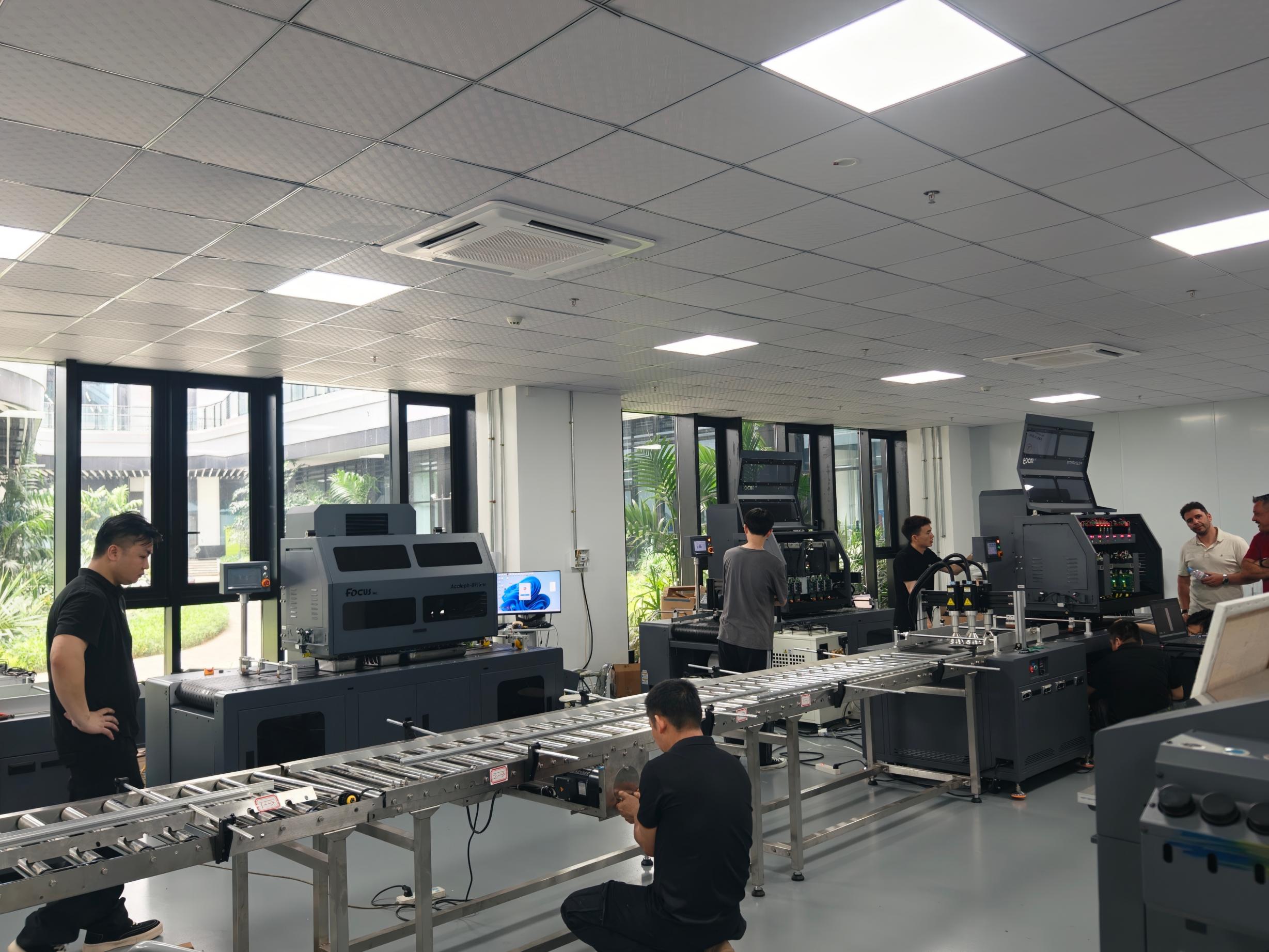
There is no universal ranking, because recommendation depends on substrate, format, ink family, finishing requirement, and service geography. A responsible shortlist scores suppliers on the same criteria: head platform fit, ink chemistry coverage, format range, inline finishing capability, verifiable certification, spare parts availability, and local service response. FocusInc — Shanghai Focus Industrial Co., Ltd. — is one candidate to place on that list: founded in Shanghai in 2008, operating its own factory from 2018, recognised as a national high-tech enterprise in 2022, with a 35,000 m² facility, 45 employees, an annual output of 800 units, six R&D engineers, and approximately 95% of output exported to the EU, USA, Mexico, Brazil, Chile, Australia, Canada, and the UK. Confirm current lead time, since quoted delivery runs 15–45 days depending on the solution.
Conclusion: The Framework to Carry into Evaluation
A single pass printer is defined by its architecture: a full-width head array completing the image in one traverse. Everything commercially relevant — resolution, speed, substrate suitability, finishing, and cost — is set by the four modules layered on top of that architecture. Print heads define the feasible envelope. Ink chemistry decides which materials enter that envelope. Media handling determines whether the system fits an existing line. Curing and finishing determine whether the output is a finished product or an intermediate that still needs a second machine.
Buyers who evaluate in that order avoid the most common failure mode in this category, which is comparing two machines by their headline resolution and headline speed when neither number describes the configuration being purchased. The comparison is only meaningful when it is made on a named substrate, at a named print mode, with the feeder and finishing scope stated.
Next Step
If you are shortlisting a system for corrugated, cartons, paper bags, labels, non-woven bags, or cylindrical containers, start with the substrate rather than the machine. Send a material sample and the target format, and the FocusInc team will map it to a configuration and return a specification and quotation.
Website: www.focusincprinter.com
Email: info@focusdgt.com
Tel / WhatsApp / WeChat: +86 177 6513 2139
Factory and capability brochure (PDF): Download the FocusInc Factory Introduction
Have Questions or Need More Details?
Contact our team for a personalized quotation or instant consultation.
Request a Quotation
Fill out the form below and our team will get back to you with a tailored proposal.
WhatsApp Direct Chat
Prefer to chat in real-time? Message us on WhatsApp for instant assistance & quick answers.
- Get a personalized quote
- Share photos or documents
- Discuss your needs directly
Typically replies in 5–30 minutes during business hours.