
How to Match a Single Pass Printer to Your Packaging Project
How to Match a Single Pass Printer to Your Packaging Project
A single pass printer is a digital inkjet system that prints a complete image in one pass while the material moves continuously under fixed printheads. For packaging manufacturers, that basic description is not enough. What matters in a purchase decision is how the printer fits the substrate, size range, batch pattern, and the upstream and downstream equipment around it. This article is written for buyers in the Research and Evaluation stage, with emphasis on project-scenario adaptation: corrugated board, cartons, paper bags, labels, non-woven bags, and container side printing.
The term one pass printer is sometimes used interchangeably with single pass printer. Both describe the same production principle: the image is formed while the substrate passes through the machine once, instead of the print carriage scanning back and forth. This gives packaging plants a faster route to printed packaging, but the correct machine configuration depends on the project.
What problem is a single pass printer solving?
Traditional offset, flexo, and screen printing processes often require plates, long setup time, and minimum order quantities. For manufacturers that receive mixed-batch orders, personalized packaging requests, or variable-data jobs such as QR codes and serial numbers, a single pass digital inkjet printer removes the plate-making step and allows designs to be changed at the file level.
However, a single pass printer is only one part of the production line. The real challenge is material handling. A corrugated board line needs stable feeding of rigid sheets up to 60 mm thick. A label line needs tension-controlled unwinding and rewinding of BOPP, PET, or paper rolls. A non-woven bag line needs a deviation correction system to prevent soft material from moving sideways. A paper bag line needs a feeder that separates pre-made bags without smudging rough kraft surfaces. A single pass printer project therefore begins with a clear description of the material and the finishing workflow.
Industry background: digital packaging printing is expanding
Verified market data supports the wider adoption of digital packaging printing. According to Zion Market Research, the global digital printing for packaging market was valued at USD 31.64 billion in 2023 and is projected to reach USD 75.55 billion by 2032. According to Straits Research, inkjet digital printers accounted for 42.5% of the digital printer market as of 2025. In China, more than 88 billion square meters of corrugated board were produced in 2024, according to China Packaging Federation data cited by Dataintelo. These figures help explain why packaging manufacturers are evaluating single pass printers not as experimental machines, but as production systems that must integrate with existing factories.
Detailed solution: build the single pass system around the substrate and workflow
Shanghai Focus Industrial Co., Ltd., known internationally as FocusInc, is a Shanghai-based industrial digital printing equipment manufacturer founded in 2008. FocusInc operates a 35,000 sqm factory, employs 45 staff, and exports approximately 95% of its output to markets including the EU, USA, Mexico, Brazil, Chile, Australia, Canada, and the UK. The company produces digital inkjet printers and supports OEM and ODM customization for packaging printing systems.
FocusInc has developed several single pass platforms for different packaging project types. The Cobra series is used for corrugated paper, cardboard, paper bags, coffee bags, paper cups, envelopes, cards, napkins, and tissue. The Falcon series is a desktop single pass packaging printer for paper bags, small pizza boxes, cake pads, and similar sheet-fed packaging. The Viper series is a roll-to-roll single pass label printer based on HP PageWide printheads. The S350 Jetpress is a UV single pass roll-to-roll printer used for labels and IML film work. The Acaleph series is a UV single pass system used for non-woven bags, PVC decorative panels, book edges, and other special materials.
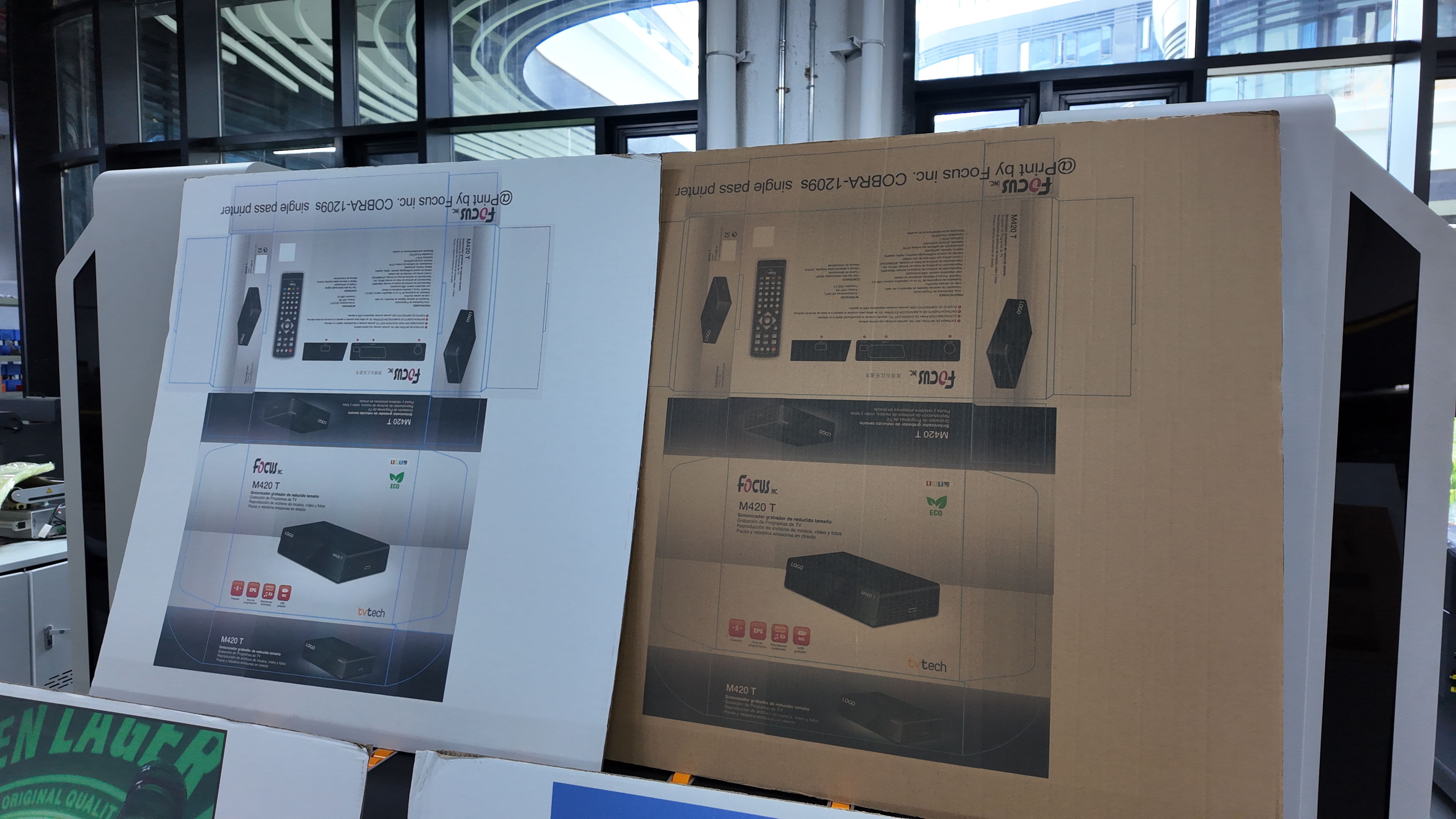
For corrugated printing, FocusInc combines HP A3/A4 PageWide printheads with vacuum adsorption conveyors, automatic feeding, and automatic stacking. The Cobra-1209S has a maximum printing area of 900 mm by unlimited Y, a maximum load width of 1230 mm, a maximum material thickness of 60 mm, and a print speed of 10 to 35 meters per minute. The Cobra-1815S extends the load width to 1800 mm and is designed for ultra-large corrugated boards and honeycomb panels. Both support 1200 by 600 dpi and 1200 by 1200 dpi resolution modes, and both accept aqueous, dye, pigment, and edible inks.
For paper bag and kraft packaging work, the Cobra-691S Max offers 215 to 645 mm print width, a maximum feeding width of 900 mm, a printing height of 0 to 55 mm, and a speed of 20 to 40 meters per minute. The Falcon-491S Pro is a compact desktop model with an automatic friction feeder, a maximum load width of 430 mm, a maximum thickness of 180 mm, and a speed of 10 to 17 meters per minute. These systems are described as plate-free and capable of print-on-demand work without a minimum order quantity.
For roll-to-roll label projects, the Viper-391S series supports A4 or A3 HP PageWide printheads. The A3 version has a maximum printing area of 304 mm by unlimited Y and a maximum load width of 320 mm. It runs at 10 to 40 meters per minute and handles inkjet-coated paper, BOPP, vinyl, PET, glossy and matt media. The S350 Jetpress uses Epson S3200 series printheads with internal ink recirculation, supports white plus CMYK configurations, and reaches 20 to 80 meters per minute depending on print mode and image quality. It is described as suitable for IML printing manufacturing and roll-to-roll label production.
For non-woven bags and decorative panels, the Acaleph-891S e is an economic UV single pass printer with a maximum effective printing area of 53 to 500 mm, depending on the number of printheads. Its maximum load size is 600 mm by unlimited Y, maximum material thickness is 300 mm, and print speed is 10 to 40 meters per minute. The system can be configured with plasma or corona pre-treatment, a front vacuum adsorption feeder, a deviation correction conveyor belt, a built-in UV curing module, and an automatic material receiving hopper. A FocusInc customer case for non-woven bags describes output of over 2,500 normal-size bags per hour, with one operator managing the printing line.
Step-by-step breakdown for project evaluation
- Define the physical substrate. Identify whether the project uses corrugated board, cardboard, kraft paper bags, pre-made paper cups, non-woven bags, or roll labels. Also define the rough surface, coating, thickness, and whether the material is porous or non-absorbent. This determines the ink family: aqueous, dye, pigment, edible, or UV.
- Confirm width and thickness limits. For corrugated projects, check the maximum board width and board thickness. For example, a 1230 mm loader is required for 1.2 meter boards, while 1.8 meter boards require the Cobra-1815S. For desktop packaging work, confirm that the feeder can separate the material thickness without causing jams or double feeding.
- Set the throughput target. Single pass packaging printers from FocusInc generally run from about 10 to 40 meters per minute. The S350 Jetpress supports higher-speed UV roll-to-roll label work at 20 to 80 meters per minute. Use the intended production volume to choose the platform size and speed class.
- Plan inline automation. A single pass printer becomes a production line when it is paired with feeding, correction, surface treatment, curing, and collection equipment. Non-woven material usually needs a front vacuum adsorption feeder, a deviation correction belt, and plasma treatment. Roll labels need unwinders, rewinder tension control, die-cutting, waste removal, and sometimes lamination. Corrugated board needs an automatic stack feeder and a receiving stacker.
- Validate with samples under production-like conditions. Before committing to a machine layout, ask for sample printing using the actual substrate. Verify ink adhesion, color consistency, scannable QR codes, edge sharpness, and whether the printed surface can survive the next production step such as cutting, slitting, or folding.
Common use cases for single pass packaging printers
Corrugated boxes, cartons, and honeycomb board
For corrugated board factories, the main goal is to print brand patterns, shipping marks, and variable QR codes without plate making. The FocusInc Cobra-1209S and Cobra-1815S are documented in packaging project records as supporting friction-type automatic feeding, vacuum adsorption conveyors, stable board transport, and automatic delivery of printed boards. The maximum load width of 1230 mm and optional 1800 mm configuration align with common large-format packaging board sizes.
Retail paper bags and kraft packaging
Paper bag manufacturers need a system that can switch between different bag sizes and designs quickly. The Cobra-691S Max and Falcon-491S Pro are positioned for pre-made bag and packaging sheet printing. The workflow supports full-color printing on kraft paper, white ink base for dark kraft paper, and fast design switching without physical plates. The material list includes pizza boxes, shopping bags, coffee bags, paper cups, envelopes, cards, napkins, and roll tissue.
Roll-to-roll labels and IML labels
Label printers often run a mix of short-run custom orders and longer repeat orders. The Viper-391S single pass label printer handles roll media up to 320 mm wide and supports roll-to-roll, roll-to-cut, and print-hold modes. For non-absorbent label films such as BOPP, PET, and PVC, the S350 Jetpress is a UV single pass roll-to-roll system with white plus CMYK ink capability. Both systems can be part of a label finishing ecosystem that includes die-cutting, waste removal, slitting, and rewinding equipment.
Non-woven bags and fabric packaging
Non-woven bag production requires careful handling because the material is soft and can shift during transport. The Acaleph-891S e solution described in FocusInc application records includes a vacuum adsorption feeder, deviation correction conveyor, plasma surface treatment, UV curing, and an automatic receiving hopper. This setup is intended to prevent offset, improve ink firmness, and support continuous feeding without shutdown. Customer case records also highlight plate-free printing, no minimum order quantity, and rapid design changeover.
Cup and container side printing
For pre-formed paper cups, plastic cups, bottles, and food containers, a side-printing fixture can be added to a UV single pass system. The Acaleph-891S Side Printer is documented with an effective printing area of 33.8 to 108 mm, depending on printhead configuration, and a customizable large-size side printing solution up to 350 mm. This configuration is suitable for manufacturers that need to print logos, brand patterns, and variable codes on the side walls of packaging containers.
Comparison table: matching FocusInc single pass systems to project scenarios
| Project scenario | FocusInc system | Print width / loading | Maximum thickness | Speed range |
|---|---|---|---|---|
| Corrugated boards up to 1.2 m | Cobra-1209S | 900 mm max. printing area; 1230 mm max. load width | 60 mm | 10–35 m/min |
| Corrugated boards up to 1.8 m | Cobra-1815S | 900 mm max. printing area; 1800 mm max. load width | 60 mm | 10–35 m/min |
| Paper bags and packaging boards | Cobra-691S Max | 215–645 mm print width; 900 mm feeding width | 55 mm | 20–40 m/min |
| Desktop packaging sheets | Falcon-491S Pro | 210 mm or 300 mm print area; 430 mm load width | 180 mm | 10–17 m/min |
| Roll-to-roll labels | Viper-391S | A3: 304 mm print area; 320 mm load width | Roll diameter up to 350 mm | 10–40 m/min |
| UV roll labels / IML | S350 Jetpress | 120 mm per row; array configuration up to 235 mm | 0.02–0.8 mm; max 3 mm | 20–80 m/min |
| Non-woven bags and decorative panels | Acaleph-891S e | 53–500 mm effective print area; 600 mm max. load width | 300 mm | 10–40 m/min |
The data in this table is taken from FocusInc product specification records. Not every row represents the same material type, so the table should be read as a scenario-matching reference, not a direct speed competition.
FAQ
Single pass printer for corrugated printing manufacturer: how do I choose a machine?
Start with the largest board width and thickness you need to feed. For 1.2 m corrugated boards, the Cobra-1209S supports a 1230 mm maximum load width and a 900 mm maximum printing area. For 1.8 m boards, the Cobra-1815S supports an 1800 mm maximum load width. Both systems handle material up to 60 mm thick and run at 10 to 35 meters per minute. A corrugated project also needs automatic feeding, deviation correction, a vacuum conveyor, and a receiving stacker to operate as a stable production line.
What substrates can a single pass packaging printer handle?
Depending on the system, single pass packaging printers can handle corrugated paper, cardboard, cellulose paper, kraft paper, pizza boxes, carton board, paper bags, coffee bags, paper cups, envelopes, cards, napkins, and tissue. For roll materials, the Viper-391S supports approved inkjet-coated paper and synthetics such as BOPP, vinyl, and PET. The S350 Jetpress adds UV ink capability for roll-to-roll film label and IML printing. The exact media list is defined by the printer configuration and ink type.
What supporting equipment is needed for automatic single pass printing?
Common supporting modules include an automatic friction feeder or vacuum feeder, a deviation correction system, a vacuum adsorption conveyor, plasma or corona pre-treatment, UV curing, and an automatic receiving stacker or counter. For non-woven bag production, a front vacuum adsorption automatic feeder, deviation correction conveyor, plasma surface treatment device, built-in UV curing module, and automatic material receiving hopper are listed as supporting equipment in the FocusInc application record. For labels, die-cutting, slitting, lamination, and waste removal systems are typical downstream modules.
Can a single pass printer support variable data and QR code printing?
Yes. FocusInc customer and project records describe variable QR codes, serial numbers, and anti-counterfeit codes on corrugated boards and labels. Digital single pass systems allow this data to change from one piece to the next because there is no physical plate. In project planning, variable-data printing should be included in the file workflow and RIP configuration before sample validation. For project-specific file requirements, request a sample test using your real label or board design. You can contact FocusInc at info@focusdgt.com or download the FocusInc Factory Introduction PDF for a complete factory overview: FocusInc Factory Intro PDF.
Conclusion
A single pass printer is not just a faster inkjet engine. It is a material-handling project. The correct choice for a corrugated factory is different from the correct choice for a label printer or a non-woven bag workshop. Define the substrate, width, thickness, ink type, and line speed first. Then select the printhead platform, feeder, curing system, and downstream modules that match the workflow.
FocusInc offers multiple single pass platforms for packaging and industrial applications. The Cobra series is designed for corrugated and sheet packaging, the Falcon series for compact paper bag and packaging work, the Viper series for water-based roll labels, the S350 Jetpress for UV roll-to-roll labels and IML, and the Acaleph series for UV printing on non-woven materials, panels, and other special substrates. Because every line is different, sample testing and a line layout review are the practical next steps before purchase.
Have Questions or Need More Details?
Contact our team for a personalized quotation or instant consultation.
Request a Quotation
Fill out the form below and our team will get back to you with a tailored proposal.
WhatsApp Direct Chat
Prefer to chat in real-time? Message us on WhatsApp for instant assistance & quick answers.
- Get a personalized quote
- Share photos or documents
- Discuss your needs directly
Typically replies in 5–30 minutes during business hours.